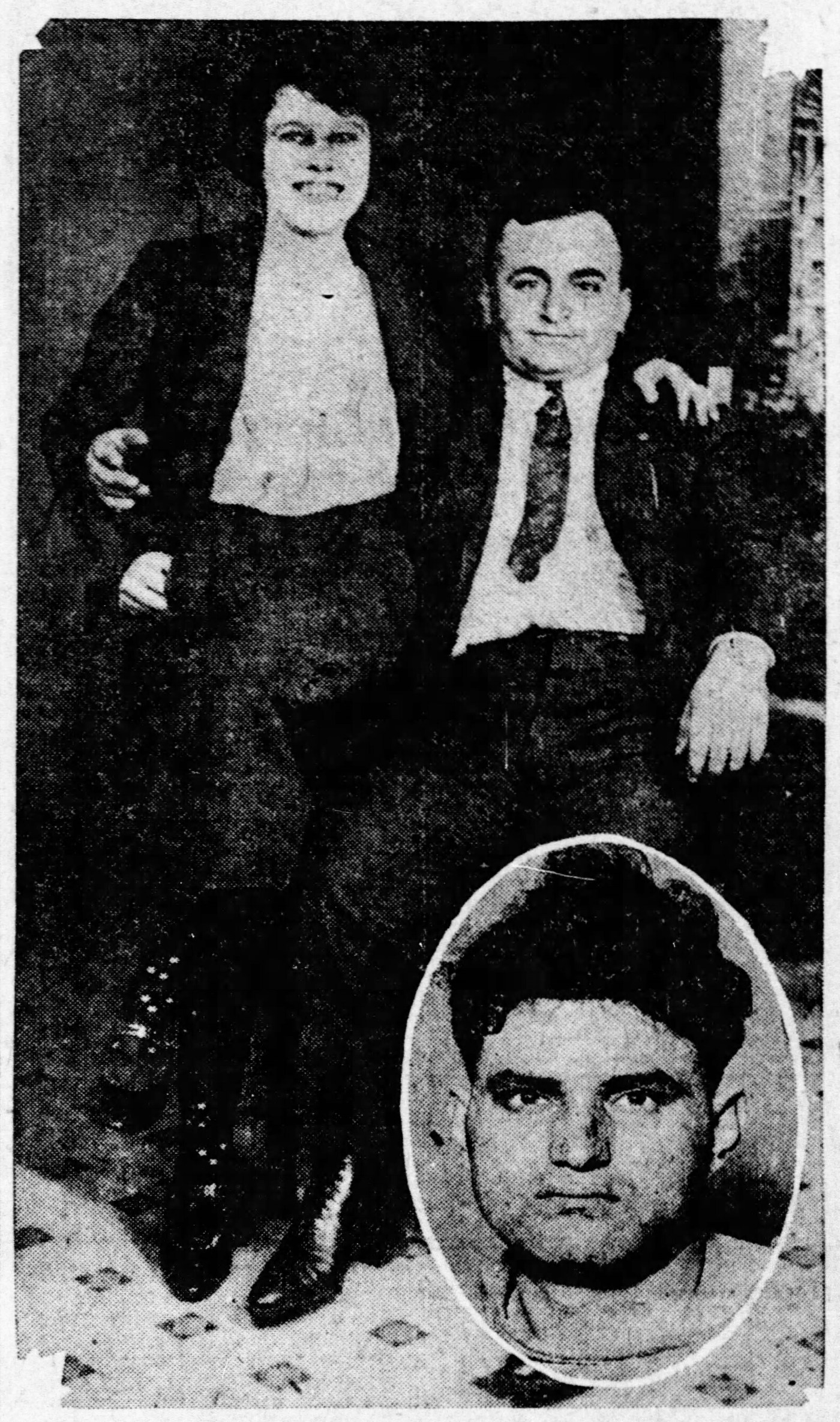
Mrs. Ida Vogel had been asleep for several hours when she was woken suddenly by the sound of gunfire. She rushed to find her adult children, Chris and Hilda, who had also been startled awake by the noise. Sliding doors rumbled open in the front rooms, and minutes after the first shots were fired, the transom over the Vogels’ apartment door lit up as two more gunshots broke through the silence [15]. When police arrived at the apartments above the confectionery on Hickory Street, they found the lifeless bodies of Golden Helen Ebrecht and her husband, Said Alawi [12, 15, 18].
Golden Helen Ebrecht, known mostly as “Helen”, was born in Missouri in September 1899, to Charles Adam Ebrecht, a farmer, and Emma Pearl Turpin [1, 2, 6, 11, 12]. Helen was the fifth-born of ten children [1, 2]. She resided with her large family in rural St. Francois County, Missouri until she wed the Syrian confectioner, Said Alawi in about 1922 [5, 6, 7, 15].
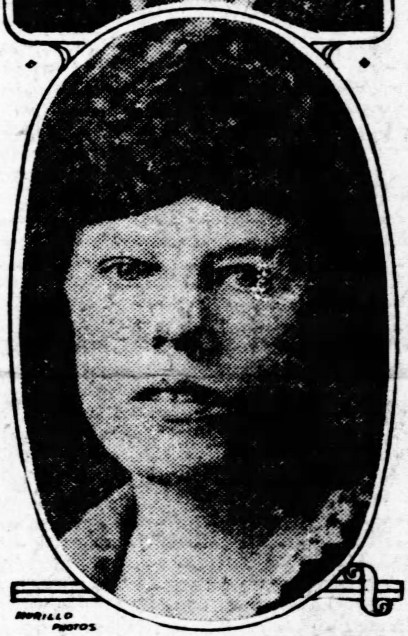
Said, who anglicized his name to “Sidney Alaway”, was born on Christmas Day 1892 in Burin, Syria – though this area is now located within Palestine [4, 11, 15]. He immigrated to the United States in 1913, and made his way to St. Louis, where he found employment at the International Shoe Factory [4, 8]. A few years after Said’s arrival in the United States, Congress passed the Eighteenth Amendment, which forbade the “manufacture, transport, sale, import, and export of intoxicating beverages, or those with more than one-half percent alcohol.” Before Prohibition, Missouri had been the seventh largest producer of beer in the nation, and unsurprisingly, many Missourians had little respect for the Act [3]. Said was arrested in November 1921 after police confiscated a pint bottle of liquor, as well as six 2-ounce bottles of imitation champagne flavoring (with 82% alcohol content) hidden in his ice cream stand [18]. He would be arrested on fourteen more occasions, and fined three times, for violating federal liquor laws [10, 15].
Despite his trouble with the law, Said transformed his ice cream cart into a brick and mortar confectionery in a building at 1929 Hickory Street [9]. The second floor of the shop was comprised of four rooms in a row, one behind the other. Said and Helen lived in the first room, Said’s cousin, Hammie Shane, lived in the second, and the Vogels occupied the two rear rooms [15]. Hammie, who suffered from epilepsy, had been injured while serving in the first World War. He worked as a clerk at his cousin’s shop to supplement his disability wages from the government [9, 15].
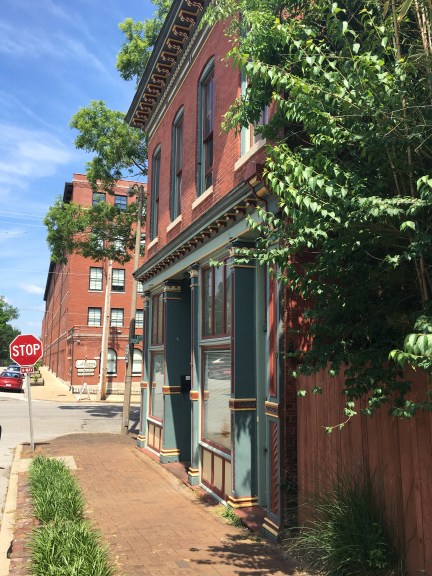
On the night of Friday, June 15, 1923, Mrs. Vogel overheard the Alawis returning to their room around 10 PM. The couple was arguing, but this was nothing out of the ordinary [15]. Helen was known to be “insanely jealous” of her husband, and often accused him of associating with other women [10]. She routinely accompanied Said to the store during business hours, and he was sure to avoid conversation with any women customers while she was present. Helen was aware of the reputation caused by her stormy temper, and had told neighbors, “There would be no trouble if I could only keep my mouth shut!” [15] The couple’s quarreling subsided, and the occupants of the apartments were soon asleep, only to be woken to the sound of gunfire just before 1 AM. The Vogels listened in shock as Said’s cousin, Hammie, pushed through the sliding doors between his and the Alawis’ rooms. Helen, with a bloodstained revolver in hand, shouted, “Oh, Hammie, Said is shot!” No response was heard from Mr. Shane, but moments later, two more shots were fired, and the rooms again fell silent. Hammie cried out, as if to himself, “My poor cousin is dead,” and was then heard running from the apartment [10, 15].
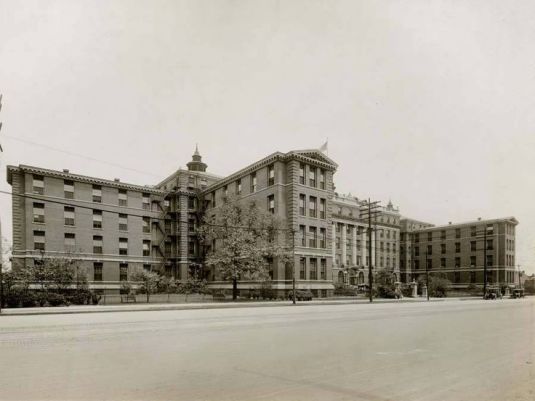
A night watchman at the shoe factory across the street heard the shots, and rang for the police. Lieutenant James Moran and Officer Immken of the Soulard district responded to the call [15], and apprehended Hammie a few blocks away at the intersection of Mississippi and Choteau Avenues. Hammie was visibly distressed, wearing an undershirt smeared with blood [10]. The policemen brought Hammie back to the apartments, where they found Helen lying on the floor in the center of the room. She had been shot once over her left eye, and again in her right temple. She had bruises on her arms and knees. Said was in bed, with multiple bullet holes in his right arm, one in the right side of his head, and another through his left jaw. A bloody revolver lay on a table in the room. It smelled as though it had recently been fired. While the policemen surveyed the gruesome scene, Hammie slipped away into his closet, and reappeared in the room, carrying a revolver. The officers wrested the gun from the his hands, and took the distraught man to the Soulard Police Station. The gun was determined to be empty, but also smelled as though it had been recently fired. While confined in his cell, Hammie repeatedly rammed his head against the iron bars, causing the officers to worry that he may try to kill himself. He was relocated to the City Hospital, where he remained violently upset for several hours [15].
Hammie Shane was charged with two counts of homicide in the days after the murders. Helen’s elder sister, Mabel Ebrecht Maples, made a statement to the papers that Helen had expressed fear of Hammie, and had wanted him to move out [15]. However, police reportedly theorized that Helen had killed Said in a “fit of jealousy”, and she was, in turn, murdered by Hammie [10]. Initially, Hammie claimed that he had no knowledge of the shootings. He stated that he had only fired six shots out the window to attract the attention of police when he found the couple, already dead [10, 15]. Three neighbors negated this account, and confirmed the Vogels’ story – reporting that they also heard five gunshots followed by a period of silence, and then two additional shots – not six in a row [15].
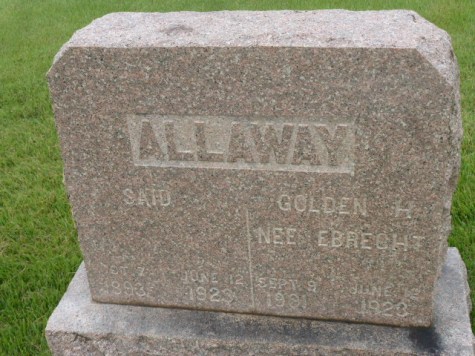
Despite the shadowy circumstances of their deaths, Said and Helen were buried together in the Knights of Pythias Cemetery in Farmington, St. Francois County, Missouri [12]. Hammie Shane was indicted for Helen’s murder just a few days after the couple’s burial, but the jury refused to charge him in Said’s death, per one report [13]. Another paper, published a few years afterward, stated that he had been convicted of the “double murder” [17]. Either way, he was judged to be insane, and committed to the City Sanitarium to serve out his sentence. In the summer of 1924, Hammie escaped from the institution, and went on to develop an alarming reputation – especially as I can find no record of bad behavior prior to 1923. Hammie was accused of bootlegging, shooting Missouri State Senator Michael Kinney, and brandishing a rifle in a district court hearing. Hammie was subsequently given the nickname, “The Terrible Turk”, and was killed in a shootout with police officers in February 1925 at the age of twenty-seven. After his funeral, which was attended only by the policemen who shot him, Hammie was buried in Caruthersville, Missouri, where he had once owned a farm [15, 17].
Afterword
Who really killed Said – Helen or Hammie? If Hammie was such a “homicidal maniac”, as reported in the papers, why can I find no record of him committing a crime prior to 1923? One of the articles cited reported that a large amount of cash (over $3,000) was found in the Alawi’s dresser, and if Hammie had intended to murder his cousin and his wife that night, you would expect that he would have taken the money and made a run for it. However, the cash was left untouched. I’m inclined to believe the original story – Helen shooting Said, and Hammie shooting Helen – and perhaps Hammie had a mental breakdown afterward, rapidly descending into a life of crime. What do you think?
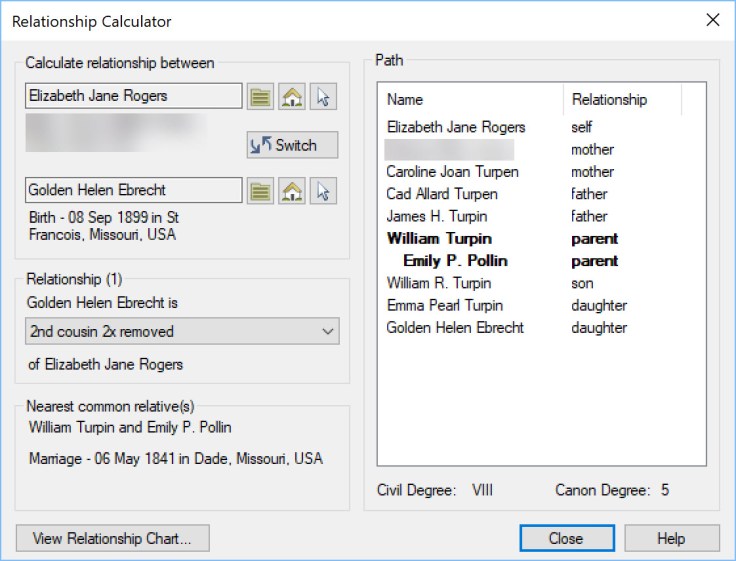
How Are We Related?
Sources
- “Charles A. Ebrecht,” undated clipping from an unidentified newspaper, archived on MackleyGenealogy.com. [Probably published shortly after 29 September 1942 near Knob Lick, Missouri per information in the obituary.]
- “Mrs. Chas. Ebrecht,” undated clipping from an unidentified newspaper, archived on MackleyGenealogy.com. [Probably published shortly after 28 December 1944 near Knob Lick, Missouri per information in the obituary.]
- “Prohibition in Missouri.” MissouriLife.com, 4 Jan. 2013, http://www.missourilife.com/life/prohibition-in-missouri/.
- “U.S., World War I Draft Registration Cards, 1917-1918,” database and digital images, Ancestry.com (http://www.ancestry.com : accessed 13 March 2017), search for Seid Alway, born 25 Dec 1892; St. Louis (Independent City), Missouri. United States, Selective Service System. World War I Selective Service System Draft Registration Cards, 1917-1918. Washington, D.C.: National Archives and Records Administration. M1509, 4,582 rolls. Imaged from Family History Library microfilm.
- 1900 United State Census (Free Schedule), St. Francois Township, St. Francois County, Missouri; p. 14A, family 277, dwelling 260; April 29, 1910; National Archives Microfilm T623, Roll 887.
- 1910 United State Census (Free Schedule), Liberty Township, Saint Francois County, Missouri; p. 2A, lines 1-11; April 29, 1910; National Archives Microfilm T624, Roll 808.
- 1920 United State Census (Free Schedule), Liberty Township, St. Francois County, Missouri; p. 6B, lines 66-74, family 141, dwelling 137; April 29, 1910; National Archives Microfilm T625, Roll 944.
- 1920 United State Census (Free Schedule), St. Louis Township, Independent City, Missouri; p. 16B, line 93; January 17, 1920; National Archives Microfilm T625, Roll 950.
- Cousin Held for the Murder Man and Wife, Maryville, Missouri, Daily Democrat-Forum, 16 June 1923, p. 1, col. 3.
- Cousin Is Held After Man and Wife Are Slain, St. Louis, Missouri, St. Louis Post-Dispatch, 16 June 1923, p. 1, col. 5-7.
- Death Certificate for Golden Helen Alaway, 16 June 1923, File No. 20107, Missouri State Board of Health.
- Golden Helen Ebrecht Allaway (1899 – 1923), Find A Grave, 13 Nov. 2016, http://www.findagrave.com/cgi-bin/fg.cgi?page=gr&GRid=172694689.
- Hammie Shane is Indicted in Murder of Mrs. Alloway, St. Louis, Missouri, The St. Louis Star and Times, 21 June 1923, p. 4, col. 6.
- Homicide Verdict Holds Prisoner in 2 Killings, St. Louis, Missouri, The St. Louis Star and Times, 18 June 1923, p. 6, col. 3.
- Man and Wife Shot to Death in Home Over Store, St. Louis, Missouri, St. Louis Post-Dispatch, 16 June 1923, p. 1, col. 6-7 and pg. 2, col. 7.
- Margaret O. Squires, Facebook Message to author, 13 March 2017 [This message discusses the transliteration of Said Always’s name and his possible city of birth.]
- Shane Died Trying to Escape Posse that Trapped Him, St. Louis, Missouri, St. Louis Post-Dispatch, 11 Feb 1925, p. 3, col. 1.
- Whisky Found on Truck: Driver Says He Was Hired to Take “Olive Oil” to City, St. Louis, Missouri, St. Louis Post-Dispatch, 01 November 1921, p. 31, col. 4-5.
 Rogers & Jones
Leave a comment